A Black Friday website crash happens when an online store becomes slow or unavailable during peak shopping traffic, leaving customers unable to browse, log in, add to cart or pay. It is a form of ecommerce downtime, and it hits when traffic, ad spend and purchase intent are at their annual peak. This year Black Friday falls on November 27 and Cyber Monday on November 30.
That leaves little time to find the weak points in your infrastructure, but enough to fix the most important ones.
Black Friday doesn’t break healthy stores, it exposes weak ones
Most Black Friday outages are not caused by a sudden, exotic failure. They come from small architectural weaknesses that stay invisible at normal traffic levels:
- A single entry point. One proxy, one server or one unclustered load balancer in front of the shop means one failure takes everything down.
- Uneven traffic distribution. If requests pile onto one backend while others sit idle, the busiest node saturates first and response times degrade for everyone.
- Failing backends that keep receiving traffic. Without reliable health checks, users are routed to a node that is already unresponsive.
- Sessions tied to a single node. If a node fails or is restarted, carts and logins can disappear in the middle of checkout.
- Traffic that is not customers. Bots, scrapers, credential-stuffing attempts and DDoS traffic consume the same capacity as real shoppers.
What an outage looks like at 9:05 on Black Friday
Imagine that the campaign email goes out at 9:00. By 9:05, traffic has multiplied. One application node saturates and pages start timing out. Customers who already had items in their cart hit errors at payment and leave. Paid campaigns keep sending clicks to a site that is not converting. Support receives tickets, and the team is switching between logs, dashboards and server consoles to find where the problem is.
A simple way to estimate the impact is minutes of downtime multiplied by your revenue per minute during the campaign, before adding wasted ad spend.
The business impact goes beyond the minutes of downtime. A large share of annual demand is concentrated in a few days, so sales lost in that window are hard to recover later. Ad budget is spent on visits that cannot buy, and customers who meet an error at checkout remember it. For technical teams, the pressure is personal: they recommended and operate the platform that failed.
How SKUDONET helps prevent a Black Friday website crash
An Application Delivery Controller (ADC) is a layer that sits between users and application servers. It distributes traffic across backends, checks which ones are healthy, keeps sessions consistent and filters malicious requests before they reach the application. A load balancer covers the first of those tasks. An ADC combines several of them in one platform.
SKUDONET is an ADC that combines load balancing, high availability and a web application firewall (WAF) in a single platform. Each weakness above maps to a specific mechanism:
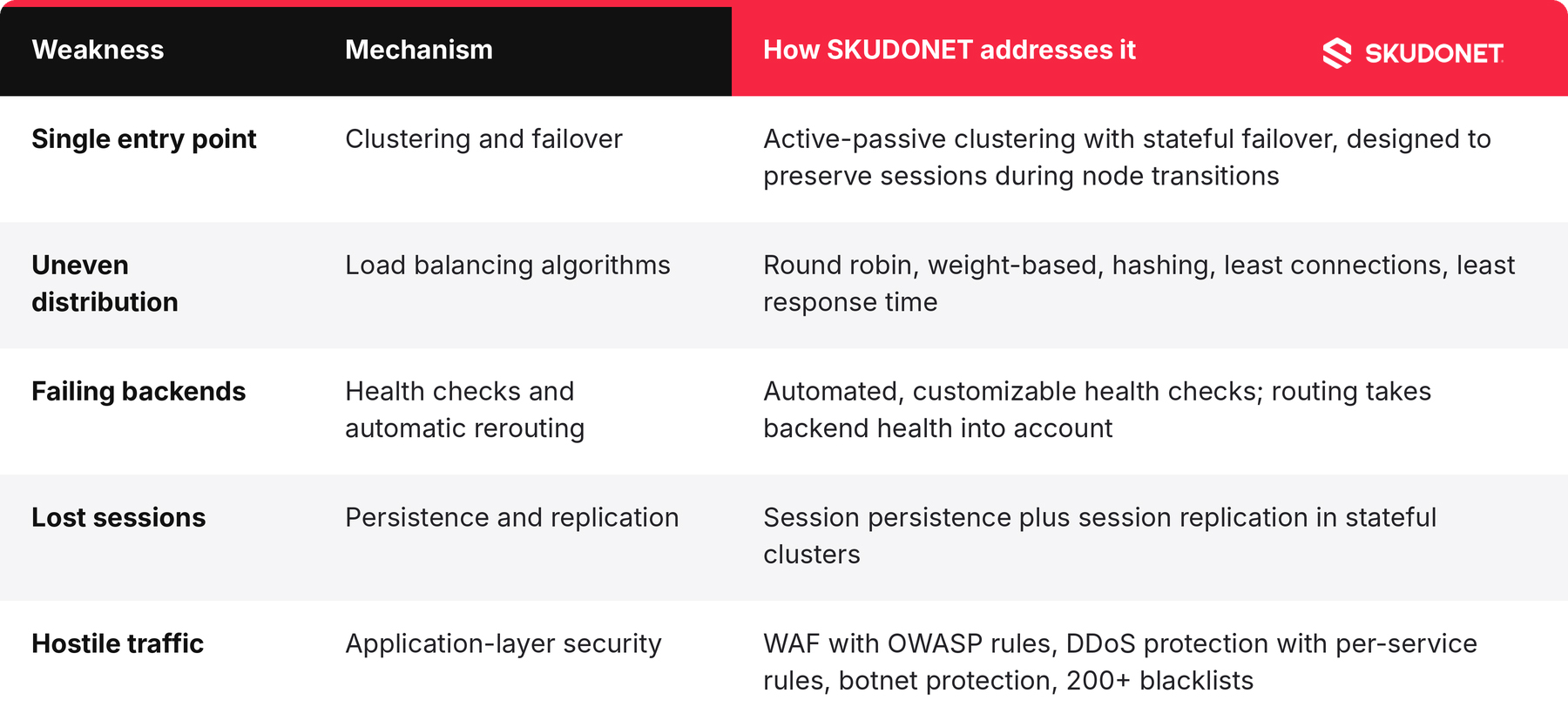
Two details are worth getting right before the peak:
Health checks must test the application, not just the port. A server can accept connections and still fail to serve a checkout page. Configure checks against endpoints that reflect real application health.
Persistence matters most where state matters most. Cart, login and payment steps are the flows where losing a session costs a sale. Review how persistence is configured for them. Our guide to sticky sessions in a load balancer explains the options, and round robin load balancing covers how the default algorithm distributes traffic.
Our checklist for the days left before Black Friday
This is the list we would work through with any ecommerce team in the final days before the peak:
- Map the critical path: product pages, search, cart, checkout and payment callbacks. Prioritize these.
- Remove single points of failure at the entry layer.
- Review health checks so they validate real application responses.
- Verify session persistence for cart and login.
- Estimate your expected peak of concurrent users and load test with margin above it. Use last year’s campaign data and your ad plan as a starting point; the worst-case estimate is the useful one.
- Test failover before the freeze: simulate a node failure in staging under load.
- Validate WAF rules against checkout and payment flows to avoid blocking legitimate customers.
- Check certificate expiry dates and renewal automation.
- Monitor real user experience during the campaign, not only whether servers are up: response times and error rates on checkout are the signals that show a problem early.
- Define alerts and owners: who is notified, and who acts.
- Freeze non-essential changes until the peak has passed.
If you do not yet have this layer in place, we recommend not introducing a new component a few days before Black Friday without testing it first. Deploy it in a staging environment, and decide with your team whether to go live now or after the peak.
Choosing a deployment model
SKUDONET can be deployed in different ways, so the choice depends on your infrastructure:
- Enterprise Edition on virtual machines, bare metal or hardware appliances: for teams that keep the shop on-premises or in a hybrid setup and want control over where traffic is processed.
- SkudoCloud: a managed SaaS option for teams that prefer not to operate the load balancer themselves.
- Cloud marketplaces (Amazon Web Services, Google Cloud and Microsoft Azure): for teams whose ecommerce platform already runs in one of these clouds and want to deploy SKUDONET next to it, from the marketplace they already use.
- Multi-site setups: DNS-based Global Server Load Balancing (GSLB) distributes traffic between data centers.
A Black Friday website crash usually comes from a short list of known weaknesses: single entry points, uneven distribution, undetected failures, lost sessions and hostile traffic. An ADC addresses each of them at the delivery layer, provided health checks, persistence and security rules are configured and tested against the real checkout flow. It works alongside capacity planning for the database and payment integrations, not in place of it.
If you want to see how this works in your own environment, you can try SKUDONET Enterprise Edition for 30 days.
FAQ
Why do ecommerce websites crash on Black Friday?
Websites usually crash on Black Friday because traffic exceeds what one part of the infrastructure can handle, often a single server, database or payment integration. Weak health checks, sessions tied to one node and automated traffic make it worse. The cause is rarely one large failure; it is usually a weakness that normal traffic never exposed.
What is ecommerce downtime?
It is any period when customers cannot complete normal shopping actions such as browsing, logging in, adding to cart or paying. It includes full outages and severe slowdowns that make checkout unusable.
How does a load balancer prevent downtime?
It spreads requests across several servers, stops sending traffic to servers that fail health checks, and removes the single point of failure at the entry layer when deployed in a cluster.
What is the difference between a load balancer and an ADC?
A load balancer distributes traffic. An ADC adds capabilities such as health monitoring, session persistence, SSL/TLS handling and application security, such as a WAF, in a single platform.
When should an e-commerce company use a WAF?
When the shop handles customer accounts or payments and faces automated or malicious traffic. A WAF filters application-layer attacks such as SQL injection and cross-site scripting before they reach the application.
What are alternatives to Netscaler or F5 for ecommerce?
Options include other commercial ADCs, open-source proxies and cloud-native load balancers. The right choice depends on deployment model, security needs and operational capacity.