

For years, NetScaler has been one of the most widely used Application Delivery Controllers (ADCs) in enterprise environments. Many organisations rely on NetScaler to ensure high availability, application security, and traffic management across critical infrastructures.
However, in recent years, companies have started to evaluate alternative ADC platforms for several reasons, including:
- licensing complexity
- vendor dependency
- infrastructure modernization
- the need for simplified operations
In addition, the growing importance of digital sovereignty and infrastructure resilience has encouraged many European organisations to explore alternative platforms.
In this guide, we review the leading European alternatives to NetScaler available today.
What is NetScaler?
NetScaler (Citrix ADC) is an Application Delivery Controller designed to optimise, secure, and control application traffic across enterprise infrastructures.
Typical capabilities include:
- Layer 4 and Layer 7 load balancing
- SSL/TLS offloading
- Web Application Firewall (WAF)
- traffic optimization and routing
- high availability clustering
These platforms are usually deployed in front of applications to ensure:
- performance
- security
- availability
Because ADC platforms sit at the entry point of many critical systems, they play a key role in infrastructure reliability.
Why Companies Are Looking for NetScaler Alternatives
While NetScaler remains a powerful platform, many organisations are currently evaluating alternatives. Some of the most common reasons are as follows.
Increasing Licensing Complexity
Enterprise ADC solutions often require multiple licenses and additional modules to unlock advanced features. This can lead to increased operational costs and licensing complexity. Many infrastructure teams now prefer all-in-one platforms that include advanced capabilities from the start.
Vendor Lock-In Concerns
Some organisations prefer to reduce their dependence on a single-vendor ecosystem. Vendor lock-in can make infrastructure evolution more difficult, particularly when organisations need flexibility to deploy across hybrid environments.
Infrastructure Modernization
Modern infrastructures increasingly combine:
- on-premise environments
- virtualization
- public cloud
- hybrid architectures
Infrastructure teams, therefore, require solutions that can operate consistently across multiple environments.
Infrastructure Sovereignty
Another emerging topic is infrastructure sovereignty. Organisations operating critical services are evaluating whether key components of their infrastructure should rely on external technology providers.
This has led a growing number of European organisations to specifically seek out ADC platforms that are designed, built, and headquartered outside US jurisdiction, not just deployed there.
Top NetScaler Alternatives Built in Europe
Below are the two ADC platforms on the market today that are genuinely European in origin and headquarters.
SKUDONET
SKUDONET is a European Application Delivery Controller platform designed to provide high availability, load balancing, and advanced security in a single solution.
The platform combines application delivery and cybersecurity features into a unified architecture that can be deployed across multiple environments.
Key capabilities include:
- Layer 4 and Layer 7 load balancing
- Integrated Web Application Firewall
- intelligent traffic routing
- multi-protocol support
- clustering and high availability
SKUDONET can be deployed across a wide range of infrastructures, including:
- bare metal environments
- virtualized infrastructures
- on-premise deployments
- public and hybrid cloud environments
Unlike some enterprise solutions, all advanced capabilities are included in the platform without requiring additional modules or extra costs.
Another differentiator is the platform’s focus on ease of management, allowing infrastructure teams to control load balancing and security from a centralised interface.
Loadbalancer.org
Loadbalancer.org is a UK-based ADC vendor with a long track record in the load balancing market, focused exclusively on application delivery since its founding.
Key capabilities include:
- Layer 4 and Layer 7 load balancing
- integrated Web Application Firewall
- Global Server Load Balancing (GSLB)
- centralised management across multi-vendor ADC estates
Strengths commonly associated with Loadbalancer.org include its straightforward, subscription-based licensing model, unrestricted feature access regardless of tier, and a strong reputation for direct, responsive technical support.
Loadbalancer.org is frequently chosen by organisations that want a simpler alternative to legacy enterprise ADC platforms without sacrificing enterprise-grade capabilities.
NetScaler Alternatives Comparison
When evaluating ADC platforms, differences often go beyond feature lists. Many organisations today face challenges related to:
- complex licensing structures
- increasing operational overhead
- limited visibility across the infrastructure
- long-term dependency on specific vendors
As infrastructure environments evolve, these factors become increasingly relevant in platform selection.
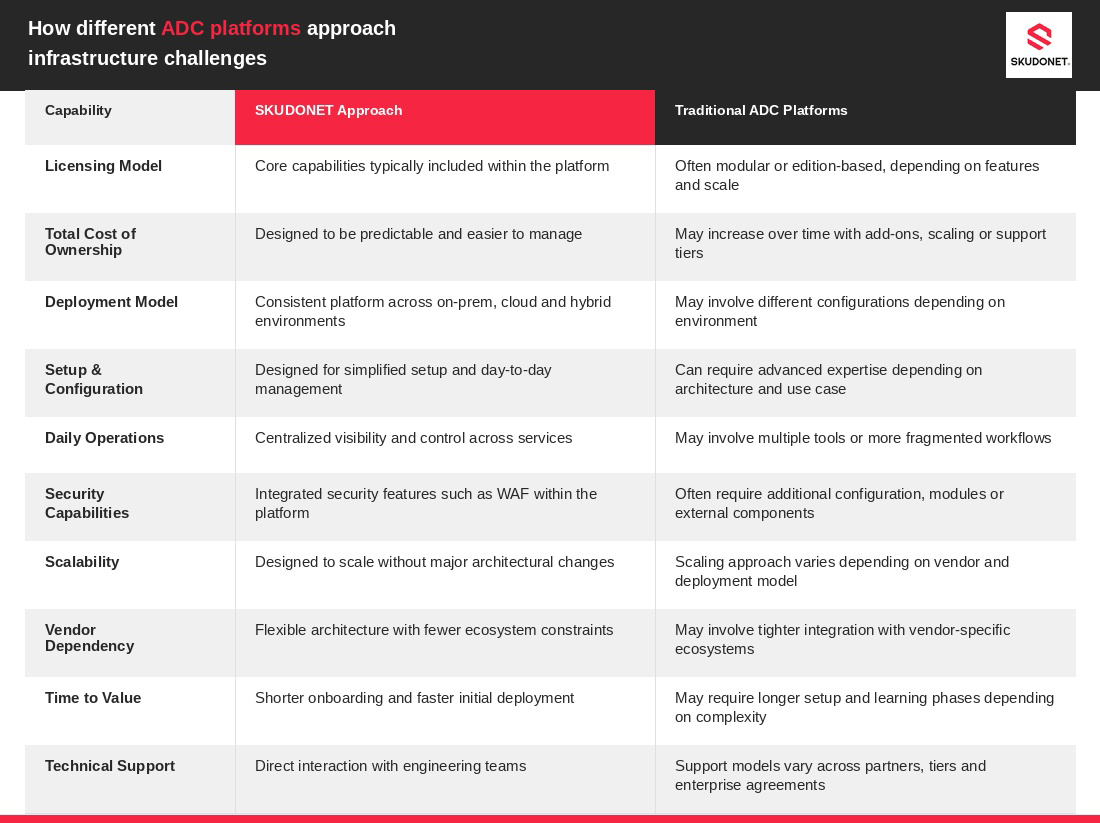
The comparison below outlines how different ADC platforms typically approach these challenges.
Note:
The comparison reflects common patterns observed across ADC platforms. Specific capabilities and configurations may vary depending on vendor, deployment model, and use case.
For many teams, selecting an ADC platform is not only about technical capabilities. It often involves balancing factors such as:
- operational complexity
- visibility and control
- long-term flexibility
- alignment with infrastructure strategy
Beyond Europe, organisations also frequently evaluate established international platforms such as F5, HAProxy, and NGINX when considering NetScaler alternatives. These remain strong, widely adopted solutions — the right fit ultimately depends on each organisation’s specific priorities around vendor origin, support model, and infrastructure strategy.
When Should You Consider Migrating from NetScaler?
Organisations typically evaluate alternative ADC platforms during several key moments. Common scenarios include:
- infrastructure modernisation projects
- cloud migration initiatives
- licensing renewal cycles
- architecture redesigns
- vendor diversification strategies
These transitions provide an opportunity to reassess infrastructure platforms and evaluate alternative technologies.
Conclusion
Application Delivery Controllers remain a critical component of modern infrastructure.
As organisations continue to modernise their environments and prioritise resilience, flexibility, and security, many teams are exploring alternative ADC platforms — including a growing number of European organisations specifically looking for European-built alternatives.
While NetScaler remains a widely used solution, a growing number of organisations are exploring alternatives that combine simplified operations, flexible deployment models, transparent licensing, and integrated security features — without needing to look outside Europe for their infrastructure stack.
SKUDONET and Loadbalancer.org represent the two most established European options for teams designing their next-generation application delivery infrastructure.
Explore Alternatives to NetScaler
Organisations evaluating alternatives to NetScaler often start with a simple question: What would a different approach to application delivery look like in practice?
If your team is currently reviewing ADC platforms, exploring different architectures and deployment models can help clarify the right direction.
At SKUDONET, we regularly work with infrastructure teams evaluating their current setup and exploring alternative approaches. If it’s useful, you can:
- explore how different deployment models work in practice
- review migration considerations from existing ADC platforms
- discuss specific infrastructure requirements with our engineering team
