This release updates the WAF engine, tightens the HTTP/2 stack and speeds up HTTP/2 and TCP SSL farms.
SKUDONET Enterprise Edition 10.4.1 is now available. The headline is the web application firewall: in a final test in a real environment, the same workload ran at 3,303 requests per second on 10.4.1 versus 1,739 on 10.4.0, with average latency dropping from 11.55 ms to 6.10 ms. Alongside it, the release speeds up HTTP/2 and TCP SSL farms and addresses recently identified HTTP/2 vulnerabilities.
A WAF engine that spends its CPU on security, not housekeeping
A WAF inspects every request before it reaches the backend, and that inspection competes for the same CPU that serves traffic. When load grows, administrators usually have two options: add hardware or relax inspection. This release tries a third one: reducing the work the engine does around each rule.
10.4.0 shipped with ModSecurity (libmodsecurity) 3.0.12. 10.4.1 ships a customized 3.0.17. It is built on PCRE2 with JIT compilation, which translates regular expressions into machine code at runtime, and it adds a set of patches written by our engineering team, aimed at how the engine uses memory:
- Fewer memory allocations. The engine now reuses the structure it needs for each regular expression match instead of creating and freeing one every time.
- No unnecessary copies. Large payloads, such as POST bodies, are moved in memory rather than copied during chained transformations.
- Faster lookups. The hash function for transaction variables was replaced with a 64-bit FNV-1a, to avoid collisions that slowed down searches.
- No wasted logging work. The engine no longer builds debug messages that the configured log level will discard.
We checked the result in a real environment, running the same workload on both versions:
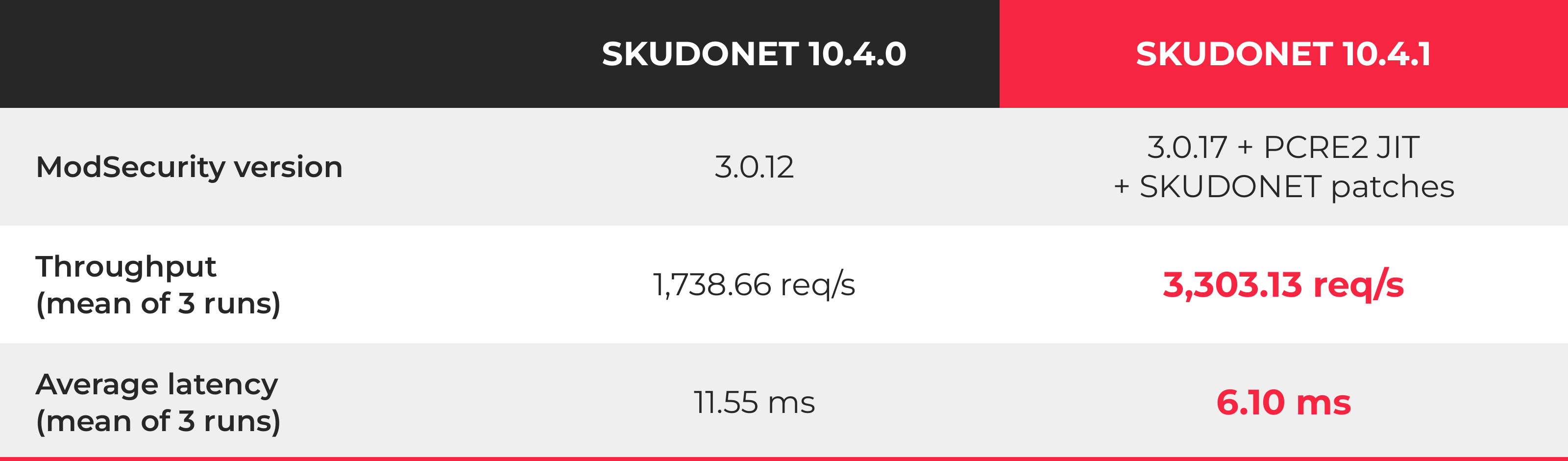
The test used wrk with two threads and 20 concurrent connections for 20 seconds, repeated three times per version. These are workload-specific results, not a guarantee for every deployment: rule sets, request size and traffic mix all change the outcome, so it is worth measuring on your own traffic. The benchmark measures the combined effect of the upgrade, the JIT compilation and the patches, not each one separately.
Speed is only useful if the WAF keeps doing its job. In lab testing with the GoTestWAF suite, the previous engine and the patched one produced identical results, with the same requests blocked.
We have also shared these optimizations with the OWASP ModSecurity project. A maintainer reviewed the ten patches and asked for them as pull requests, which are now open for review. We will cover the technical details in a separate article.
HTTP/2 and TCP SSL farms: less work per connection
The second major change targets high-concurrency scenarios. HTTP/2 multiplexes many requests over one connection, and TCP SSL farms terminate encrypted traffic for services that are not HTTP. Both put pressure on connection handling and on the cost of encrypting and decrypting data.
In 10.4.1 we optimized connection handling, internal buffer processing and encrypted traffic management in both farm types. The goal is lower processing overhead, higher throughput and better scalability when many connections are active at once.
HTTP/2 also receives a security update. The processing engine has been updated to address recently identified CVEs, which strengthens protocol security and improves resilience against malicious HTTP/2 traffic.
Also in 10.4.1
Visibility
- The Web GUI can now show Backend Stats in real-time graph mode, with backend performance, connection activity and traffic distribution. This helps spot a bottleneck while it is happening.
- The Dashboard shows clearer information about network interface configuration and status.
Security and platform
- The kernel moves to release 6.1.0-56, with improvements in security, stability and hardware compatibility.
- The IPDS Stats Collector parser has been optimized, which reduces the cost of collecting security statistics in high-traffic environments.
- skd-resource-governor has improved its handling of Linux cgroups. This helps prevent one process from starving others of resources and keeps performance consistent under load.
Certificates and service management
- Let’s Encrypt automation adds a new DNS provider, 1984hosting, so certificates for domains managed there can be issued and renewed through DNS validation.
- The Web GUI service now runs under Systemd, which improves startup reliability and integration with standard operating system tools.
Fixes
- Virtual interfaces in “down” state now show their status correctly in the Web GUI.
- The Let’s Encrypt certificate that protects the Web GUI now renews automatically, reducing manual intervention.
Test it on your own traffic
The best benchmark is your own workload. Request an evaluation of Enterprise Edition 10.4.1 and see how it behaves in your environment.