
SKUDONET Enterprise Edition 10.2.2 is now available, bringing new capabilities that give infrastructure teams more control over network paths, HTTP traffic and day-to-day ADC operations.
The release adds Last Hop support powered by eBPF, dynamic redirects for HTTP and HTTP/2 Farms, configurable backend Cookie values and a refreshed WebGUI, alongside performance, logging and reliability improvements across the platform.
What’s New in SKUDONET Enterprise Edition 10.2.2?
The main additions include:
- Last Hop support for HTTP and HTTP/2 Farms
- Dynamic redirects using regular expression capture groups
- Configurable Cookie values for HTTP and HTTP/2 backends
- A refreshed WebGUI
- Improved HTTP and HTTP/2 error logging
- CGI concurrency control and systemd integration
- Internal performance optimizations
- Fixes affecting SNI, L4xNAT, redirects and certificate renewal
Let’s look at the main changes in more detail.
Last Hop: More Control Over Asymmetric Routing
One of the most significant additions in Enterprise Edition 10.2.2 is Last Hop support for HTTP and HTTP/2 Farms.
In infrastructures with multiple routers, VLANs, stateful firewalls or redundant network paths, the route selected for a response can differ from the path through which the original connection reached the ADC.
From a routing perspective, both paths may be valid. From an application delivery perspective, however, this can introduce asymmetric routing which may result in stateful firewall sessions failing, inconsistent NAT behavior, dropped connections or security policies being applied differently depending on the traffic path.
SKUDONET Last Hop addresses this by using eBPF to dynamically learn the relevant Layer 2 path through which a connection reaches the ADC. Linux continues to perform its normal routing decision, while SKUDONET uses the learned information to preserve the appropriate return path when required.
This becomes especially relevant in multi-network environments and in architectures where a backend server can also act as a client of another load-balanced Virtual IP.
We’ve covered the architecture, eBPF implementation and asymmetric routing scenarios in much greater detail in our technical article: How SKUDONET Last Hop solves asymmetric routing with dynamic eBPF Layer 2 learning.
Dynamic Redirects for HTTP and HTTP/2 Farms
Application migrations and URL restructurings often involve large numbers of redirects, and managing every rule individually quickly becomes difficult when many URLs follow the same pattern.
Enterprise Edition 10.2.2 introduces dynamic redirects that can reuse regular expression capture groups. For example, instead of maintaining separate rules for URLs such as:
/old/products/100
/old/products/200
/old/products/300
a regular expression can capture the variable part of the URL and reuse it in the redirect destination:
/old/products/(.*) → /new/products/$1
This makes it possible to handle multiple related redirects with a single rule, simplifying configuration during website migrations, application reorganizations or URL normalization projects.
Configurable Cookie Values for Backend Persistence
Session persistence is essential when an application needs requests from the same user to keep reaching the same backend.
Enterprise Edition 10.2.2 adds the ability to configure the Cookie value associated with HTTP and HTTP/2 backends, giving more control over persistence behavior and allowing compatible services to use consistent backend cookie values when required, particularly useful when several services need to coordinate session affinity.
This type of session persistence allows persistence data to be shared across different farms and services.
A Refreshed WebGUI for Day-to-Day Management
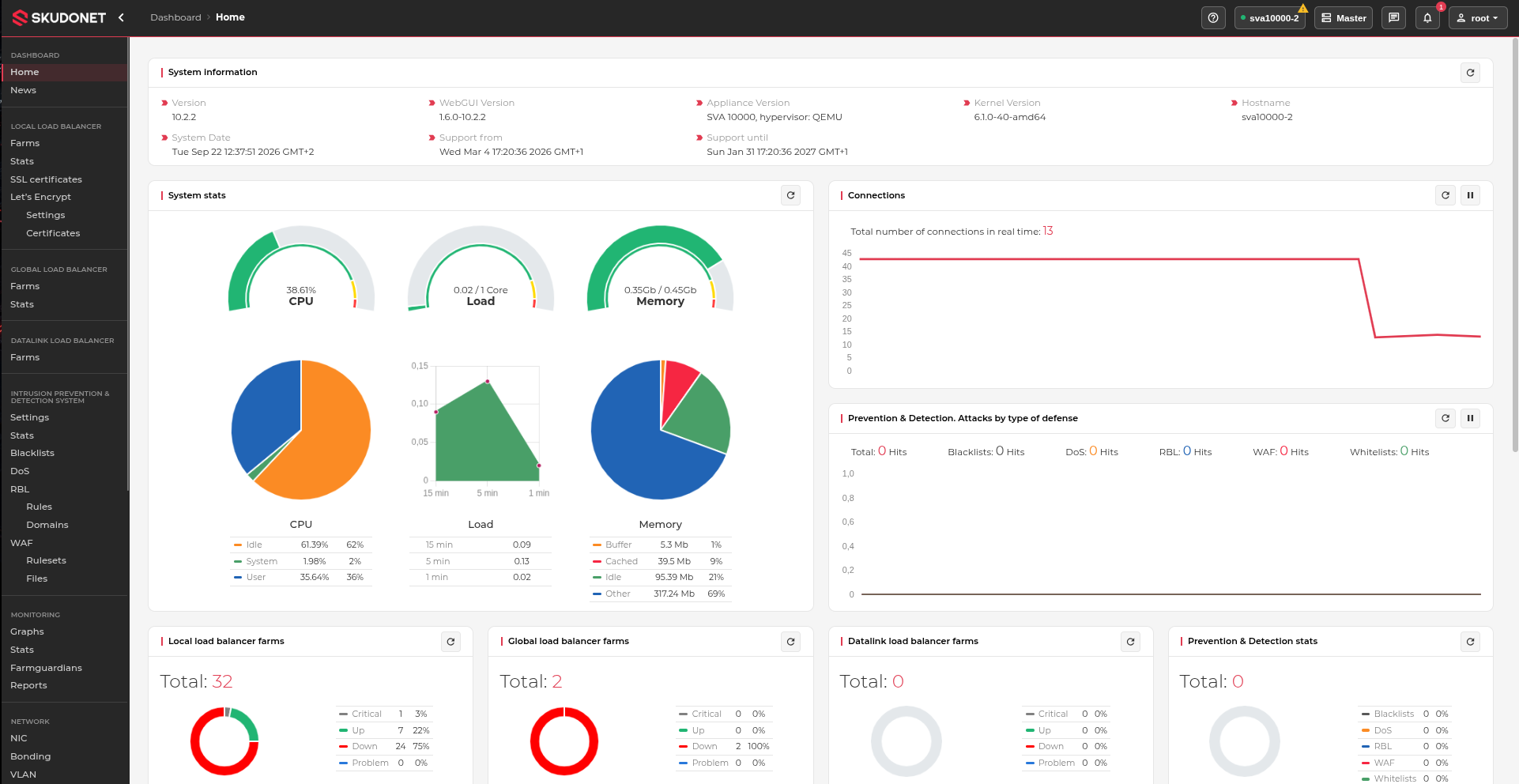
Enterprise Edition 10.2.2 also introduces an updated visual appearance for the SKUDONET WebGUI.
Managing an ADC involves much more than creating a load balancing service. Administrators regularly work with Farms, backends, certificates, networking configuration, security policies, monitoring and troubleshooting information. The refreshed WebGUI modernizes the visual experience while maintaining centralized access to the configuration and monitoring capabilities required to operate SKUDONET environments.
Better WebGUI Resource Management
The release also introduces CGI concurrency control, which limits the number of simultaneous CGI requests handled by the WebGUI to help manage resource consumption during concurrent administration operations. WebGUI process management has also been integrated with systemd, aligning it more closely with standard Linux service management.
More Detailed HTTP and HTTP/2 Troubleshooting
Enterprise Edition 10.2.2 introduces more detailed error logs when reading client and backend headers in HTTP and HTTP/2 Farms, giving administrators more context when investigating malformed requests, backend communication problems or unexpected HTTP behavior.
Traffic Handling Performance Improvements
This release also includes internal performance optimizations that improve traffic handling efficiency. These changes apply automatically and don’t require administrators to modify existing Farm configurations.
Reliability and Bug Fixes in Enterprise Edition 10.2.2
Alongside the new functionality, this release addresses several issues affecting HTTP/2, L4xNAT, redirects and SSL certificate management.
SNI Matching Is Now Case-Insensitive in HTTP/2 Farms
SNI hostname matching in HTTP/2 Farms now ignores letter case, in accordance with RFC 6125. This prevents capitalization differences in hostnames from producing unexpected matching behavior.
Improved Maintenance Handling for L4xNAT Backends
The release corrects status handling when maintenance actions are applied to L4xNAT backends that are already marked as down, making backend state management more consistent during maintenance operations.
Correct Handling of Special Characters in Redirect URLs
Literal redirect destinations in HTTP and HTTP/2 Farms are now treated as exact strings, so special characters configured within the redirect destination are preserved as expected. This also provides clearer behavior between literal redirect destinations and the new regular-expression-based dynamic redirects.
Automatic WebGUI Certificate Updates After Let’s Encrypt Renewal
When a Let’s Encrypt certificate used by the management interface is renewed, the WebGUI now applies the updated certificate automatically, removing a manual step from certificate lifecycle management.
Upgrade to SKUDONET Enterprise Edition 10.2.2
SKUDONET Enterprise Edition 10.2.2 is now available for Enterprise Edition environments with access to current software updates.
Contact our team for more information.
