
Modern applications generate more traffic, serve more users, and depend on more distributed infrastructure than ever before. Whether you are running a SaaS platform, an e-commerce website, a banking application, or a public API, ensuring traffic reaches the right resources efficiently is critical for performance, availability, and security.
This is where load balancing plays a central role.
However, modern traffic management is no longer just about distributing connections across servers. Organizations increasingly need visibility into application behaviour, real-time traffic control, and integrated security capabilities to support complex digital services.
As a result, one of the most common questions infrastructure teams face is understanding the difference between Layer 4 (L4) and Layer 7 (L7) load balancing.
The answer is not simply a matter of choosing one over the other.
Layer 4 and Layer 7 address different aspects of application delivery. While Layer 4 focuses on fast and efficient traffic distribution at the transport layer, Layer 7 introduces application awareness, enabling advanced routing decisions, security enforcement, and traffic optimization.
In modern architectures, both approaches often work together. Understanding how they complement one another is essential for designing resilient application infrastructures capable of delivering performance, availability, visibility, and security at scale.
Why Modern Applications Require More Than Basic Load Balancing
Ten years ago, many organizations operated relatively simple environments: a web application on a handful of servers behind a basic load balancer distributing incoming connections evenly.
Today’s reality is fundamentally different. Modern infrastructures must support:
- Cloud and hybrid deployments
- Containerized workloads and Kubernetes environments
- Public and private APIs
- Microservices architectures
- Multi-region applications with continuous traffic growth
- Increasingly sophisticated security requirements
As applications become more distributed, traffic management becomes significantly more complex. A load balancer is no longer simply a tool for distributing connections between servers. It has become a critical component of application delivery, helping organizations maintain availability, optimize performance, enforce security policies, and gain visibility into application behaviour.
For some workloads, simple connection-based distribution is sufficient. For others, routing decisions must consider URLs, HTTP headers, SSL certificates, API requests, user sessions, and security policies. This is precisely where the distinction between Layer 4 and Layer 7 load balancing becomes important.
What Is Layer 4 (L4) Load Balancing?
Layer 4 load balancing operates at the Transport Layer of the OSI model. Instead of inspecting application content, it makes routing decisions using network-level information: source IP address, destination IP address, TCP/UDP ports, and protocol type.
When a connection arrives, the load balancer evaluates this information and forwards traffic to an available backend server according to predefined algorithms such as Round Robin, Least Connections, or Weighted Distribution.
Layer 4 load balancing is the fastest approach to traffic distribution. Because it does not inspect packet payloads, routing decisions are made with minimal computational overhead, making it ideal for latency-sensitive workloads processing high volumes of concurrent connections.
Imagine a financial platform processing tens of thousands of encrypted TCP connections per second. The priority is handling traffic efficiently while minimizing latency. In this scenario, Layer 4 load balancing is often the most effective choice.
Where Layer 4 Adds Value
Layer 4 excels when the primary objective is processing large volumes of traffic with the lowest possible latency. Typical use cases include:
- DNS services and VoIP platforms
- SMTP infrastructure and database traffic
- High-volume TCP applications and real-time communication systems
- Internal service communication where application-layer inspection adds no value
Advantages of L4 Load Balancing
- Extremely high throughput with very low latency
- Lower resource consumption and simpler configuration
- Broad protocol support and efficient connection handling
Limitations of L4 Load Balancing
Because Layer 4 only understands network and transport information, it cannot:
- Route traffic based on URLs or HTTP headers
- Apply content-aware policies or understand API requests
- Perform application-level security inspection
- Integrate natively with WAF functionality
As applications become more sophisticated, these limitations can become significant, particularly for organizations exposing web applications, APIs, and digital services to the Internet.
What Is Layer 7 (L7) Load Balancing?
Layer 7 load balancing operates at the Application Layer of the OSI model. Unlike Layer 4, it understands application protocols such as HTTP, HTTPS, HTTP/2, gRPC, and WebSockets, enabling routing decisions based on application-specific information.
Instead of simply deciding where a connection should go, a Layer 7 load balancer understands what the user is trying to do. For example:
- /api/* can be routed to dedicated API server clusters
- /images/* can be directed to static content servers
- /checkout/* can be forwarded to payment infrastructure
- /admin/* can be restricted to administrative service pools
Layer 7 load balancing transforms traffic management from a network function into an application intelligence layer. It enables organizations to route, inspect, and secure traffic based on exactly what each request is trying to accomplish.
Where Layer 7 Becomes Essential
In many modern environments, Layer 7 capabilities are no longer optional. As organizations expose more applications, APIs, and digital services to the Internet, traffic management increasingly requires visibility, security controls, and application awareness. This is why Layer 7 functionality has become a fundamental component of modern Application Delivery and Security architectures.
Typical use cases include web applications, SaaS platforms, REST APIs, e-commerce environments, customer portals, multi-tenant applications, and Zero Trust architectures.
Advantages of L7 Load Balancing
- Content-based routing and SSL/TLS termination
- Session persistence and API traffic management
- Advanced traffic policies and granular access control
- Native WAF integration and application-level security visibility
Limitations of L7 Load Balancing
The additional intelligence comes with additional resource requirements. Compared to Layer 4, Layer 7 typically requires more CPU, more memory, more configuration effort, and greater operational expertise. For most modern web applications, however, the operational benefits significantly outweigh the overhead.
Key Differences Between L4 and L7 Load Balancing
The comparison between Layer 4 and Layer 7 is often presented as a choice between performance and functionality. In reality, modern application environments require both.
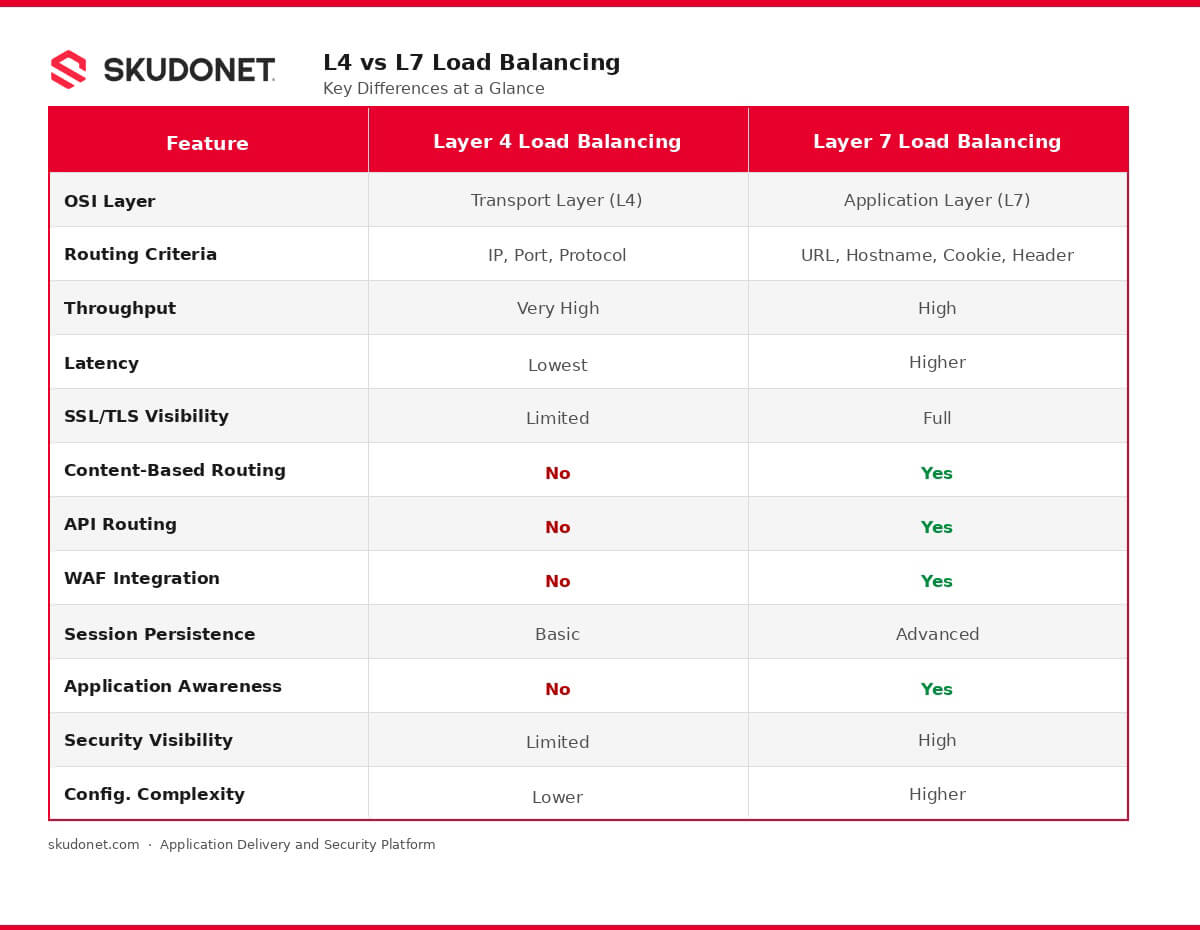
A useful way to think about it: Layer 4 answers “What connection needs to be delivered?” — Layer 7 answers “What is this request trying to do?” That distinction fundamentally changes what infrastructure teams can achieve.
Why L4 vs L7 Matters in Modern Application Architectures
Very few organizations today operate a single monolithic application running on a handful of servers. Instead, they manage ecosystems composed of APIs, microservices, Kubernetes clusters, cloud-native applications, multi-cloud environments, and distributed services.
Traffic is no longer homogeneous. A single application may include static content, dynamic transactions, authentication services, API gateways, third-party integrations, and internal microservices, each with different performance, availability, and security requirements.
Treating all traffic equally is rarely the optimal approach. Organizations increasingly need visibility into application behaviour so traffic can be routed intelligently, resources can be optimized, and security policies can be enforced consistently.
This is one of the primary reasons why Layer 7 traffic management has become such an important component of modern application delivery strategies.
When to Use L4 vs L7 Load Balancing
The right choice depends on the workload and the operational requirements behind it.
Layer 4 Is Ideal For
- DNS infrastructure, VoIP services, and SMTP platforms
- Database clusters and high-volume TCP services
- Real-time communications where latency is the primary constraint
- Internal service traffic where application-layer inspection adds no value
In these scenarios, inspecting application content adds little value while introducing unnecessary computational overhead.
Layer 7 Is Essential For
- Modern web applications and customer-facing digital services
- APIs and API gateways requiring intelligent routing
- SaaS platforms, e-commerce systems, and multi-tenant environments
- Applications requiring SSL offloading and session persistence
- Deployments requiring WAF protection and application security policies
- Environments with advanced routing requirements based on URL, hostname, or header
Organizations that attempt to manage modern web applications with Layer 4 alone frequently encounter architectural limitations as their traffic complexity and security requirements grow.
How Modern ADC Platforms Combine L4 and L7 Traffic Management
For many organizations, the discussion is no longer about choosing between Layer 4 and Layer 7 load balancing. The real challenge is how to combine both capabilities within a unified application delivery strategy.
Modern Application Delivery Controllers (ADCs) integrate Layer 4 traffic distribution, Layer 7 routing, SSL offloading, Web Application Firewall (WAF) protection, reverse proxy functionality, and high availability services into a single platform.
This approach enables infrastructure teams to optimize performance while maintaining the visibility and security controls required by today’s applications. For example, an organization may use Layer 4 load balancing to distribute high-volume TCP traffic efficiently while simultaneously applying Layer 7 policies for API routing, SSL termination, session persistence, and application security.
Why Deployment Flexibility Matters
Not every organization operates exclusively in the public cloud. Financial institutions, healthcare providers, government agencies, and organizations subject to data sovereignty requirements frequently operate on-premise or in hybrid environments where control over infrastructure is not optional — it is a compliance requirement.
For these environments, an ADC that can only be deployed as a SaaS product or cloud service is not a viable option. Organizations need platforms that can be deployed where their infrastructure actually lives: on bare metal servers, virtual machines, private cloud environments, or as part of hybrid architectures spanning both on-premise data centres and cloud providers.
Data sovereignty, regulatory compliance, and operational control are not edge cases. For many European organizations and regulated industries, the ability to deploy security-critical infrastructure on-premise is a fundamental requirement, not an optional feature.
SKUDONET addresses this challenge by combining L4 and L7 traffic management, WAF protection, SSL offloading, and high availability within a single Application Delivery and Security platform available for deployment on hardware appliances, bare metal, virtual machines, cloud environments, and hybrid architectures. This allows infrastructure teams to improve availability, simplify operations, and strengthen application security without deploying multiple disconnected solutions, regardless of where their infrastructure runs.
Beyond Load Balancing: Why Traffic Visibility and Security Matter
For years, load balancing was primarily associated with traffic distribution: prevent servers from becoming overloaded by spreading incoming connections across multiple backend systems.
While traffic distribution remains essential, modern application environments require much more. Today’s organizations must understand how traffic behaves, identify anomalies in real time, detect malicious activity, and maintain visibility across increasingly distributed infrastructures.
A traffic management platform that only distributes requests may help improve scalability, but it provides limited visibility into what is actually happening within the application environment. Modern ADC platforms address this by combining traffic delivery with observability and security capabilities, enabling teams to answer critical operational questions:
- Which services are receiving the most traffic?
- Are traffic patterns behaving normally?
- Is a sudden traffic spike legitimate or an attack?
- Which applications are experiencing performance degradation?
- Are WAF security policies being triggered?
Security Is No Longer Separate from Traffic Delivery
Historically, organizations deployed multiple independent components to manage traffic and security. A load balancer distributed traffic. A firewall protected the network. A WAF protected web applications. Monitoring platforms provided visibility. While this approach can work, it increases complexity and creates operational silos.
Modern application environments require a more integrated approach. Today, security capabilities (including WAF, SSL/TLS inspection, API protection, DDoS mitigation, and threat detection) are becoming part of the traffic management process itself. This allows organizations to inspect, filter, and control traffic before it reaches critical application resources.
Real-World Architecture Example: Combining L4 and L7 Traffic Management
To understand how Layer 4 and Layer 7 work together in practice, consider a modern SaaS platform serving thousands of users across multiple regions, including web applications, REST APIs, authentication services, internal microservices, and static content delivery.
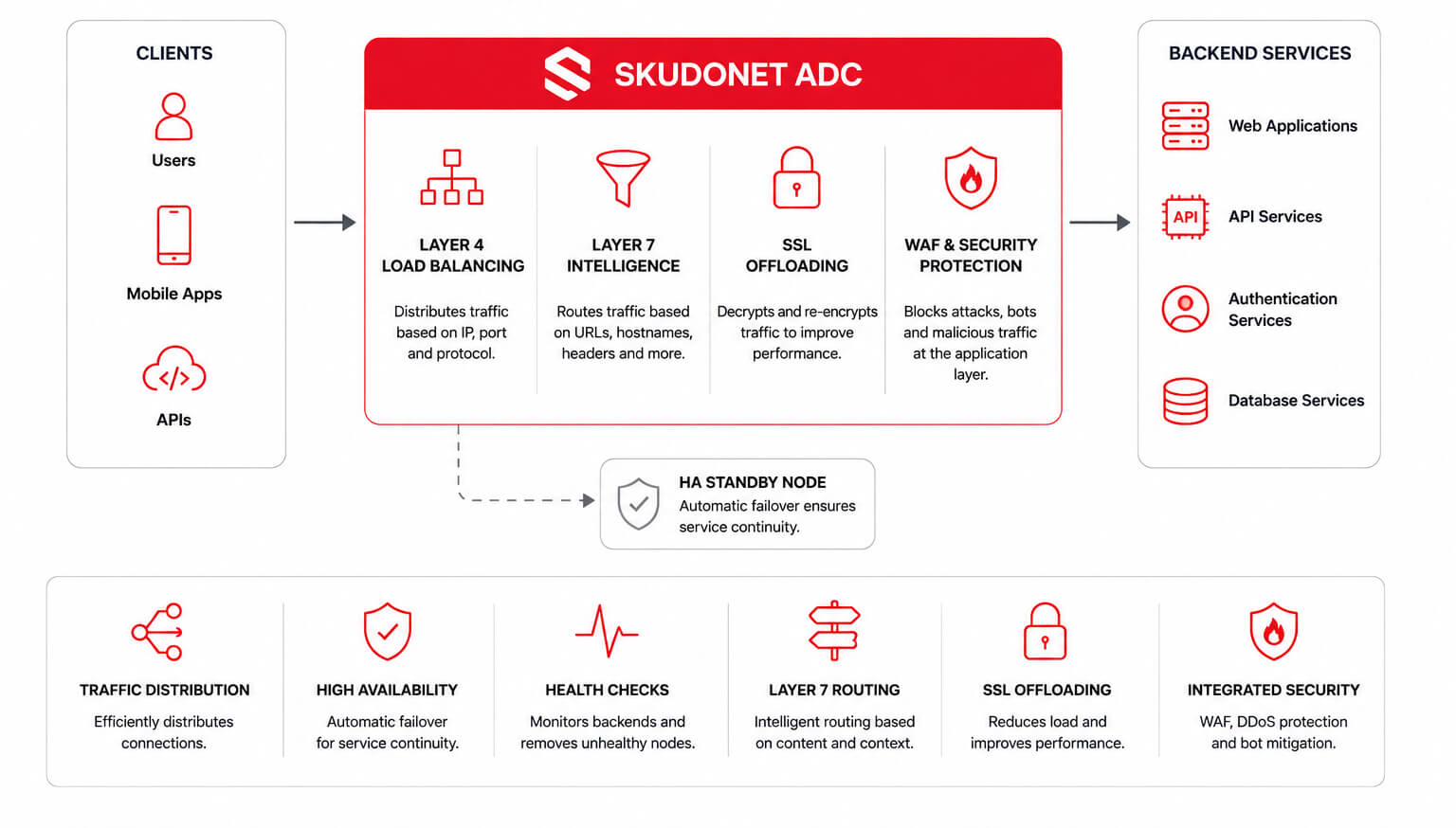
In this architecture:
- Clients (users, mobile applications, and APIs) send traffic to the ADC.
- Layer 4 Load Balancing efficiently distributes connections based on IP, port, and protocol — handling high-volume traffic with minimal latency.
- Layer 7 Intelligence routes traffic based on URLs, hostnames, headers, and session context — enabling intelligent routing to the appropriate backend service.
- SSL Offloading decrypts and re-encrypts traffic at the ADC layer, reducing backend server load and improving performance.
- WAF and Security Protection inspects and filters traffic at the application layer, blocking attacks, bots, and malicious requests before they reach backend systems.
- HA Standby Node ensures automatic failover and service continuity, eliminating the ADC itself as a single point of failure.
- Backend Services — web applications, APIs, authentication services, and databases — receive only clean, properly routed traffic.
Rather than choosing between Layer 4 performance and Layer 7 visibility, this architecture combines both within a unified platform. Infrastructure teams benefit from high-throughput traffic distribution alongside intelligent routing, integrated security, and operational observability — without deploying multiple disconnected solutions.
Common Mistakes When Choosing Between L4 and L7
One of the most common mistakes is approaching Layer 4 and Layer 7 as competing technologies. In practice, they address different aspects of traffic management and are most effective when used together.
Applying Layer 7 Everywhere Without Justification
Layer 7 provides powerful capabilities, but not every workload requires deep application awareness. Applying Layer 7 inspection to high-volume internal TCP services, database connections, or DNS infrastructure increases complexity and resource consumption without adding operational value. Layer 4 remains the right choice for workloads where latency and throughput are the primary constraints.
Relying Only on Layer 4 for Modern Web Applications
Many organizations initially deploy Layer 4 because it is simple and highly efficient. However, as applications grow in complexity, requirements emerge that Layer 4 alone cannot address: content-based routing, SSL offloading, API management, session persistence, and WAF protection. Organizations that delay the transition to Layer 7 often face significant re-architecture work when security incidents or application growth force the issue.
Treating Security as a Separate Concern
Traffic management decisions are often made with performance as the primary objective, with security controls added later as separate projects with separate tooling. This creates operational complexity, visibility gaps, and inconsistent policy enforcement. Security requirements should be incorporated into the application delivery architecture from the beginning — not retrofitted after the fact.
Ignoring Traffic Visibility Until Something Breaks
Without visibility into traffic behaviour, organizations struggle to identify performance bottlenecks, detect emerging attacks, or troubleshoot application issues under pressure. Visibility into request patterns, error rates, latency metrics, and security events is most valuable when it is always present — not only when something has already gone wrong.
Load Balancing Best Practices
Regardless of whether Layer 4, Layer 7, or a combination of both is used, several principles consistently improve performance, resilience, and operational efficiency.
Design for High Availability from Day One
Load balancers should never become single points of failure. Redundant configurations, active-passive or active-active clustering, and automated failover mechanisms are essential for business-critical services. The ADC layer itself must be as resilient as the applications it protects.
Continuously Monitor Traffic Behaviour
Traffic patterns evolve over time. Continuous monitoring helps organizations identify performance issues, capacity constraints, unusual traffic spikes, and potential security threats before they affect users. Reactive troubleshooting after an incident is significantly more costly than proactive visibility.
Use Health Checks Aggressively
Traffic should only be routed to healthy backend systems. Automated health checks ensure that failed or degraded resources are immediately removed from the active server pool, preventing users from being forwarded to unavailable services.
Integrate Security Early in the Architecture
Security controls are most effective when integrated directly into the application delivery layer rather than deployed as disconnected components added later. WAF protection, SSL inspection, and DDoS mitigation should be part of the initial architecture design, not afterthoughts.
Build for Growth and Changing Requirements
Traffic requirements rarely remain static. Infrastructure decisions should account for future growth, evolving application architectures, new API surface areas, and increasing security requirements. Choose platforms that support flexible scaling without forcing architectural redesigns as requirements change.
Conclusion
The discussion around Layer 4 and Layer 7 load balancing is often framed as a choice between performance and functionality. Modern application environments require both.
Layer 4 remains essential for delivering high-performance traffic distribution with minimal latency. Layer 7 provides the visibility, intelligence, and security controls required by modern web applications, APIs, and digital services.
As applications become more distributed and more exposed to external threats, organizations are increasingly adopting Application Delivery Controller (ADC) platforms that combine both approaches within a unified architecture — alongside SSL offloading, WAF protection, and high availability — rather than assembling disconnected point solutions.
The goal is no longer simply delivering traffic. The goal is delivering traffic efficiently, securely, and with complete visibility into how applications behave.
Explore SKUDONET’s Application Delivery and Security Platform
SKUDONET combines Layer 4 and Layer 7 traffic management, WAF protection, SSL offloading, and high availability within a single platform — available for on-premise, bare metal, virtual machine, cloud, and hybrid deployments.
- Unified ADC platform: L4 + L7 + WAF + SSL offloading in one place
- Full deployment flexibility: no mandatory cloud dependency
- Data sovereignty: designed for regulated and security-sensitive environments
- European provider: built for organizations where infrastructure control is non-negotiable
Frequently Asked Questions
What is the difference between L4 and L7 load balancing?
Layer 4 load balancing operates at the Transport Layer, making routing decisions based on IP addresses, ports, and protocols without inspecting application content. Layer 7 operates at the Application Layer, routing traffic based on URLs, HTTP headers, cookies, API paths, and user sessions. L4 prioritizes speed and throughput; L7 enables intelligent routing, security enforcement, and application visibility.
Is Layer 7 load balancing better than Layer 4?
Neither is inherently better — they solve different problems. Layer 4 is optimal for high-volume, latency-sensitive workloads such as DNS, VoIP, and database traffic. Layer 7 is essential for web applications, APIs, and services requiring content-based routing, SSL offloading, session persistence, or WAF integration. Most modern architectures use both layers together.
When should a company use a WAF alongside load balancing?
A Web Application Firewall (WAF) should be integrated whenever an organization exposes web applications or APIs to the Internet. WAF protection operates at Layer 7 and inspects HTTP/HTTPS traffic for OWASP Top 10 threats, bot activity, injection attacks, and malicious payloads. In modern ADC architectures, WAF functionality is embedded directly into the application delivery layer rather than deployed as a separate appliance.
What is an Application Delivery Controller (ADC)?
An Application Delivery Controller (ADC) is a network infrastructure component that combines load balancing, high availability, SSL offloading, reverse proxy functionality, and application security into a single platform. Modern ADCs operate across both Layer 4 and Layer 7, providing traffic distribution, intelligent routing, WAF protection, and traffic visibility. ADCs have largely replaced standalone load balancers in enterprise application delivery architectures.
What are the alternatives to Netscaler or F5 for ADC and load balancing?
Organizations evaluating alternatives to Netscaler (now Citrix ADC) or F5 BIG-IP typically consider platforms such as SKUDONET, HAProxy Enterprise, A10 Networks, and Loadbalancer.org. SKUDONET is a European ADC platform that combines L4 and L7 load balancing, WAF protection, SSL offloading, and high availability — with full support for on-premise, bare metal, virtual machine, cloud, and hybrid deployments, making it particularly relevant for organizations with data sovereignty or regulatory requirements.
Do modern ADCs support both Layer 4 and Layer 7 load balancing?
Yes. Enterprise ADC platforms combine Layer 4 traffic distribution with Layer 7 routing, security, and visibility capabilities within a single platform. This allows organizations to apply the appropriate traffic management strategy for each workload — high-performance L4 distribution for latency-sensitive services and intelligent L7 policies for web applications and APIs — without deploying separate systems.
Can load balancing improve application security?
Yes, particularly when combined with Layer 7 capabilities. At Layer 7, traffic management platforms can integrate WAF protection, perform SSL/TLS inspection, enforce API security policies, detect anomalous traffic patterns, and block malicious requests before they reach backend application servers. Modern ADC platforms treat security as an integral part of the application delivery architecture rather than a separate function.
