
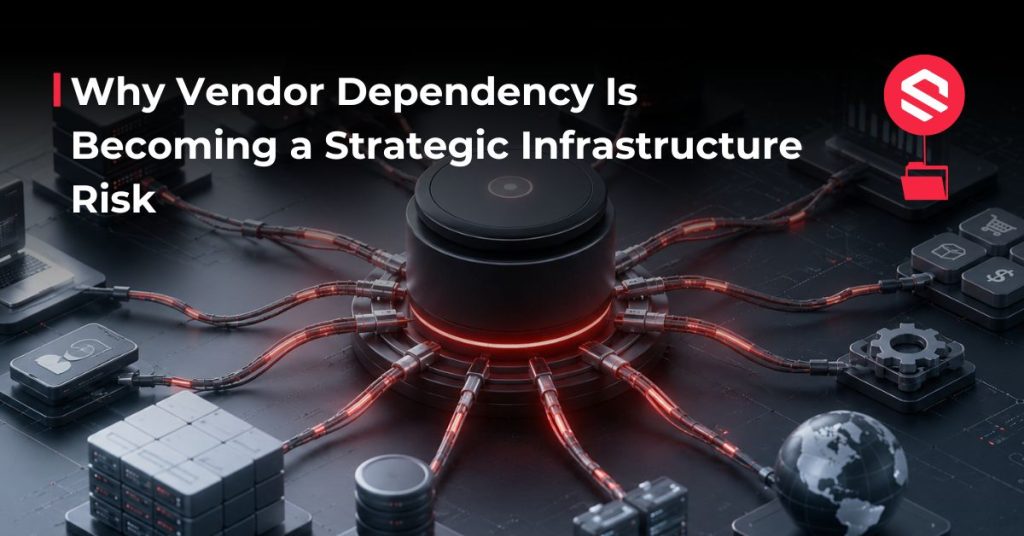
What we are seeing across enterprise ADC projects, and why more infrastructure teams are re-evaluating long-term vendor dependency.
For years, infrastructure decisions were assessed through a familiar set of criteria: performance, availability, security, compatibility and cost.
Those factors still matter. But conversations around critical infrastructure are becoming broader.
In discussions with customers, partners and infrastructure teams, another question is appearing more frequently:
How much operational and strategic dependency are we creating when a critical part of our infrastructure relies on a single vendor?
Vendor dependency becomes a strategic infrastructure risk when relying on a provider starts to limit an organization’s ability to control costs, change deployment models, evolve its architecture or respond to new operational requirements. The risk lies not in the relationship itself, but in the loss of practical alternatives.
This question is particularly relevant for Application Delivery Controllers. Sitting directly in the path of application traffic, ADCs have evolved far beyond load balancing. Today, they combine traffic management, high availability, application security and policy enforcement, making them one of the most critical layers of enterprise infrastructure.
As a result, choosing an ADC influences far more than technical performance. It can affect how easily infrastructure evolves, how predictable future costs remain, how quickly teams respond to change and, ultimately, how much control an organization retains over its own architecture.
Vendor dependency is not inherently a problem. Every organization relies on strategic technology providers. The challenge begins when that dependency becomes difficult to measure, expensive to change or no longer aligns with the organization’s long-term infrastructure strategy.
Five signs vendor dependency is becoming an infrastructure risk
Organizations rarely review an ADC platform because of a single failure.
More often, the conversation begins as infrastructure evolves, operational demands increase or commercial conditions change. Over time, a series of small decisions can lead teams to question whether the platform they selected years ago still supports the way they want to operate today.
Across enterprise ADC projects, these are the five signals we encounter most often.
These are qualitative patterns from projects and conversations with infrastructure teams and partners, not the results of a formal survey — but they are the signals that come up most consistently when organizations reassess their ADC strategy.
1. ADC licensing becomes harder to predict
Licensing is often treated as a commercial issue. In reality, it can have a significant impact on infrastructure strategy.
A platform may initially meet every technical and financial requirement, but as environments grow, the commercial model can become increasingly difficult to forecast.
This may happen when capabilities are divided across multiple editions, additional modules are required for security or management, support levels change, or infrastructure growth introduces new licensing requirements.
The question is not simply whether the platform is expensive.
It is whether the organization can confidently predict the cost of operating and expanding it over the coming years.
For CIOs, that affects budgeting and long-term planning. For infrastructure teams, it can influence architectural decisions by discouraging new deployments, delaying expansion or limiting the adoption of capabilities that are technically available but commercially difficult to justify.
It also makes the total cost of ownership harder to assess. Licensing fees may be only one part of the equation. Additional management products, security modules, specialist skills, support contracts and migration costs can all affect the long-term economics of the platform.
When licensing begins to shape infrastructure decisions more than technical requirements, vendor dependency becomes a strategic concern rather than a procurement issue.
2. Deployment flexibility across hybrid infrastructure starts to decline
Enterprise infrastructure no longer follows a single deployment model.
Many organizations now operate across a combination of on-premises systems, virtualized environments, private cloud, public cloud and geographically distributed data centers.
While many ADC platforms support these environments, support alone does not guarantee operational consistency.
The more important questions are:
- Can the same operating model be maintained across different environments?
- Can configurations move without redesigning the architecture?
- Does the organization remain free to choose where workloads run?
- Will future cloud or virtualization decisions force a change in ADC strategy?
Configuration portability is particularly important. An ADC configuration may include virtual services, health checks, persistence policies, traffic-management rules, TLS certificates, WAF policies and automation scripts. If those elements depend heavily on proprietary formats or interfaces, moving to another environment or platform can require more than deploying a replacement appliance.
Infrastructure teams increasingly value platforms that adapt to different deployment models instead of encouraging a single infrastructure path.
This matters because an ADC is rarely deployed for only a few years. The environment around it will almost certainly evolve, and today’s platform decision should not unnecessarily restrict tomorrow’s architecture.
3. Innovation begins to follow the vendor’s roadmap, not the organization’s
Every technology vendor has its own product roadmap.
The challenge arises when an organization’s priorities begin to diverge from it.
Perhaps the business needs support for a new deployment model, deeper automation, a different licensing approach or faster access to technical expertise. None of these requests may be strategically important to the vendor, even though they are important to the customer.
This is a natural consequence of large product portfolios serving thousands of organizations with different priorities.
The question is not whether the vendor continues to innovate.
The question is whether that innovation is aligned with the direction in which the customer’s infrastructure is actually moving.
When that alignment weakens, organizations can find themselves delaying projects, adapting their own plans or accepting compromises simply because changing direction has become increasingly difficult.
4. Operational complexity continues to grow
Infrastructure complexity rarely appears overnight.
It accumulates over time.
A platform that was straightforward to manage a few years ago can become increasingly difficult to operate as organizations add new applications, expand into different environments, strengthen security controls or introduce additional management tools.
For technical teams, the consequences are practical rather than theoretical.
Routine changes may require multiple interfaces. Troubleshooting can involve different products or support channels. Knowledge becomes concentrated in a small number of specialists, making day-to-day operations harder to maintain and scale.
Automation can become another source of dependency. APIs, configuration models and orchestration workflows may be closely tied to a particular platform. The more operational processes depend on proprietary implementations, the higher the switching costs become.
This affects more than operational efficiency. It can increase configuration risk, extend troubleshooting times and make even simple changes more difficult than they need to be.
For many infrastructure teams, simplicity is no longer a “nice to have”. It has become an operational requirement. A platform that is easier to understand, monitor and manage allows teams to spend less time maintaining infrastructure and more time improving it.
5. Business resilience depends on more than high availability
High availability has always been one of the primary reasons for deploying an ADC.
But resilience extends beyond keeping applications online during a technical failure. It also includes the organization’s ability to adapt when infrastructure, business priorities or commercial conditions change.
A highly available platform can still create strategic constraints if workloads are difficult to move, costs are unpredictable, expertise is hard to access or the architecture cannot evolve without significant redesign.
True resilience is therefore not simply the ability to withstand failure. It is the ability to continue operating and evolving without being unnecessarily constrained by decisions made years earlier.
When an infrastructure project triggers an ADC strategy review
One of the misconceptions surrounding ADC migrations is that they happen because an existing platform has failed.
In reality, that is rarely what we see.
More often, an unrelated infrastructure project creates an opportunity to revisit decisions that may have remained unchanged for years:
- A hardware refresh.
- A cloud migration.
- A licensing renewal.
- An infrastructure modernization initiative.
A good example is the migration carried out by Pablo de Olavide University.
What initially began as a hardware renewal became a broader assessment of the organization’s ADC strategy. Rather than simply replacing appliances, the team evaluated operational complexity, long-term costs, support and whether the existing platform still aligned with its current infrastructure objectives.
The result was a migration to SKUDONET.
Not because the previous platform had stopped working.
But because the organization concluded that a different operational model was better suited to where its infrastructure was heading.
It is a pattern we are seeing more frequently across enterprise ADC projects.
Organizations rarely migrate because yesterday’s decision was wrong. They migrate because today’s requirements are different from those that shaped the original decision.
Questions worth asking before the next ADC decision
Reviewing an ADC platform does not necessarily mean planning a migration.
Sometimes the conclusion will be that the current platform remains the right choice.
The value lies in asking whether that choice still aligns with the organization’s future direction.
A structured review should consider five areas.
Commercial predictability
- Can we predict the cost of operating and scaling the platform over the next three to five years?
- Are core capabilities included, or do they depend on additional products, modules or licenses?
- How could future changes to licensing or support affect the architecture?
Deployment and configuration portability
- Can we deploy consistently across physical, virtual, cloud and hybrid environments?
- Can configurations, policies and operational processes move between environments?
- Are we dependent on proprietary formats or platform-specific tooling?
Operational maintainability
- How easy is it for our teams to monitor, troubleshoot and evolve the platform?
- Is operational knowledge distributed across the team or concentrated in a few specialists?
- Can the platform integrate with our existing automation and observability workflows?
Roadmap alignment
- Does the current ADC still support our infrastructure roadmap?
- Is the vendor’s product direction aligned with our automation, security and deployment requirements?
- Can we access technical expertise quickly when it matters most?
Exit readiness
- Do we understand the technical and operational cost of changing platforms?
- Can configurations and policies be documented or exported in a usable format?
- Is there a realistic migration path if the platform no longer meets our requirements?
- Would we make the same decision if we were selecting an ADC today?
These questions are not intended to create dissatisfaction with an existing vendor.
They are intended to determine whether the current platform continues to create more value than constraint.
An exit strategy does not mean an organization expects to leave its provider. It means the organization understands what would be required if circumstances changed. That knowledge makes vendor dependency measurable rather than assumed.
Looking beyond the next renewal
Organizations do not need to eliminate vendor dependency.
In practice, every enterprise depends on strategic technology partners.
The goal is to understand where that dependency exists, whether it remains acceptable and how it might affect future infrastructure decisions.
That means looking beyond current availability and performance. Organizations should also consider switching costs, configuration portability, interoperability, roadmap alignment and whether a practical exit strategy exists.
The EU’s NIS2 Directive is a useful external reference point here: recital 90 calls for coordinated supply chain risk assessments to identify critical dependencies and single points of failure, the same concern this article addresses at the ADC layer.
The best time to ask these questions is not when an urgent migration becomes unavoidable. It is during the routine planning cycles in which architecture, costs and operational requirements are already being reviewed.
By treating vendor dependency as a strategic consideration rather than simply a procurement issue, organizations give themselves more options for the future. That optionality is one of the most valuable forms of infrastructure resilience.
Frequently Asked Questions About Vendor Dependency
What is vendor dependency?
Vendor dependency refers to the degree to which an organization’s operations, infrastructure or business strategy rely on a specific technology provider.
Dependency itself is not necessarily a risk. It becomes a concern when it limits flexibility, makes costs difficult to predict, restricts architectural decisions or makes it difficult for the organization to adapt as infrastructure and business requirements evolve.
What is the difference between vendor dependency and vendor lock-in?
Vendor dependency is a natural outcome of working with strategic technology providers.
Vendor lock-in occurs when changing provider becomes technically, operationally or commercially difficult. This may be caused by proprietary technologies, non-portable configurations, specialist knowledge requirements, contractual conditions or high migration costs.
All organizations have some level of vendor dependency, but not all experience vendor lock-in.
When does vendor dependency become a strategic infrastructure risk?
Vendor dependency becomes a strategic infrastructure risk when it starts to influence decisions that should be based on technical or business requirements.
Warning signs include unpredictable licensing, declining deployment flexibility, increasing operational complexity, misalignment with the vendor’s roadmap and the absence of a realistic exit strategy.
How can organizations reduce vendor dependency in an ADC strategy?
Organizations can reduce vendor dependency by prioritizing deployment flexibility, configuration portability, documented APIs, interoperability and predictable licensing.
They should also understand switching costs, document operational processes and periodically test whether the platform continues to support their infrastructure roadmap.
Using multiple vendors is not the only option. The objective is to preserve practical alternatives and avoid unnecessary constraints.
Continue the conversation
Every ADC evaluation starts for a different reason, but the objective is the same: ensuring today’s infrastructure decisions continue to support tomorrow’s requirements.
If your team is reviewing its ADC strategy—or simply wants a second technical perspective—we would be happy to share our experience and discuss the architectural considerations that typically emerge during these evaluations.
