
What really happens when your web application fails?
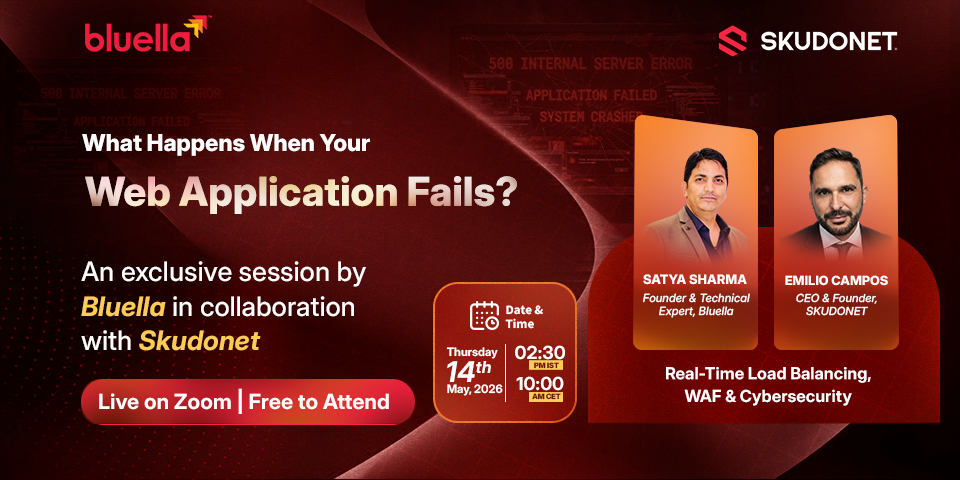
Together with Bluella, a company specialized in infrastructure and cybersecurity solutions, we’ll walk through real-world scenarios showing how modern applications break under pressure and how to maintain control in real time.
📅 Live Webinar | 14 May 2026 | 10:00 AM CET | 2:30 PM IST
The session will focus on practical, real-time demonstrations of traffic spikes, cyberattacks, and failover scenarios, offering a clear view of what actually happens behind application downtime.
Why Web Applications Fail (And Why It’s Not About Bugs)
Most teams still assume that application failures are caused by bugs.
But in reality, that’s rarely the case.
- Applications don’t simply “break”.
- They get overwhelmed.
- They get attacked.
- They behave in ways that are difficult to predict.
And here’s the real issue:
By the time teams notice something is wrong, it’s already too late.
What Really Happens Before Downtime
- Traffic spikes can silently degrade performance before any alert is triggered
- DDoS attacks don’t always look like attacks at first
- Malicious requests blend in with legitimate traffic
- Infrastructure appears stable until it suddenly isn’t
And when this happens, the impact is not only technical: it’s operational, it’s financial and it’s personal.
- For CTOs and IT leaders, it means uncertainty and pressure (not knowing if the infrastructure will hold when it matters most).
- For engineers and DevOps teams, it means firefighting under stress, trying to understand what’s happening without full visibility.
- For developers, it means dealing with issues that are not in the code, but still affecting application behavior and user experience.
The result is always the same:
- Loss of control.
- Delayed reaction.
- And in many cases, avoidable downtime.
The Real Problem: Lack of Visibility and Control
The root problem is not just traffic or security.
It’s lack of visibility and control.
In many environments:
- Load balancing is managed in one place
- Security tools operate in isolation
- Monitoring is fragmented
This creates blind spots.
And blind spots are where failures begin.
From Reaction to Control
Understanding the problem is important.
But what really matters is seeing how it happens and how it can be controlled.
Modern infrastructures need to:
- Detect anomalies early
- Manage traffic intelligently
- Block malicious requests in real time
- Maintain availability under pressure
This is where visibility and control become critical.
See It in Action: Live Webinar
To address these challenges, Bluella and SKUDONET are hosting a live webinar focused on real-world scenarios and practical demonstrations.
Live Webinar | 14 May 2026 | 10:00 AM CET | 2:30 PM IST
Hosted by Bluella in collaboration with SKUDONET
What You’ll See
During the live session, attendees will experience:
- How DDoS attacks and traffic spikes impact application availability in real time
- How SQL Injection attempts are identified and mitigated before they escalate
- How Cross-Site Scripting (XSS) attacks can silently redirect users without their knowledge
- How load balancing and failover mechanisms ensure continuity under pressure
All demonstrated live, showing how these challenges can be handled in practice using SKUDONET’s platform.
Who Should Attend
This session is designed for:
- Infrastructure and DevOps engineers
- Security teams and architects
- CTOs and IT decision-makers
- Organizations running critical applications
If you want to understand what really happens behind application failures and see how to handle it in practice:
