
Together with Bluella, we’ve hosted a live technical webinar around a problem that many infrastructure and cybersecurity teams eventually face:
What actually happens when applications start failing under pressure?
Not in theory.
Not in a slide deck.
But in real environments, with real traffic, real attacks, and real operational stress.
From the beginning, the idea behind the session was simple: instead of talking about infrastructure problems abstractly, we wanted to show them happening live.
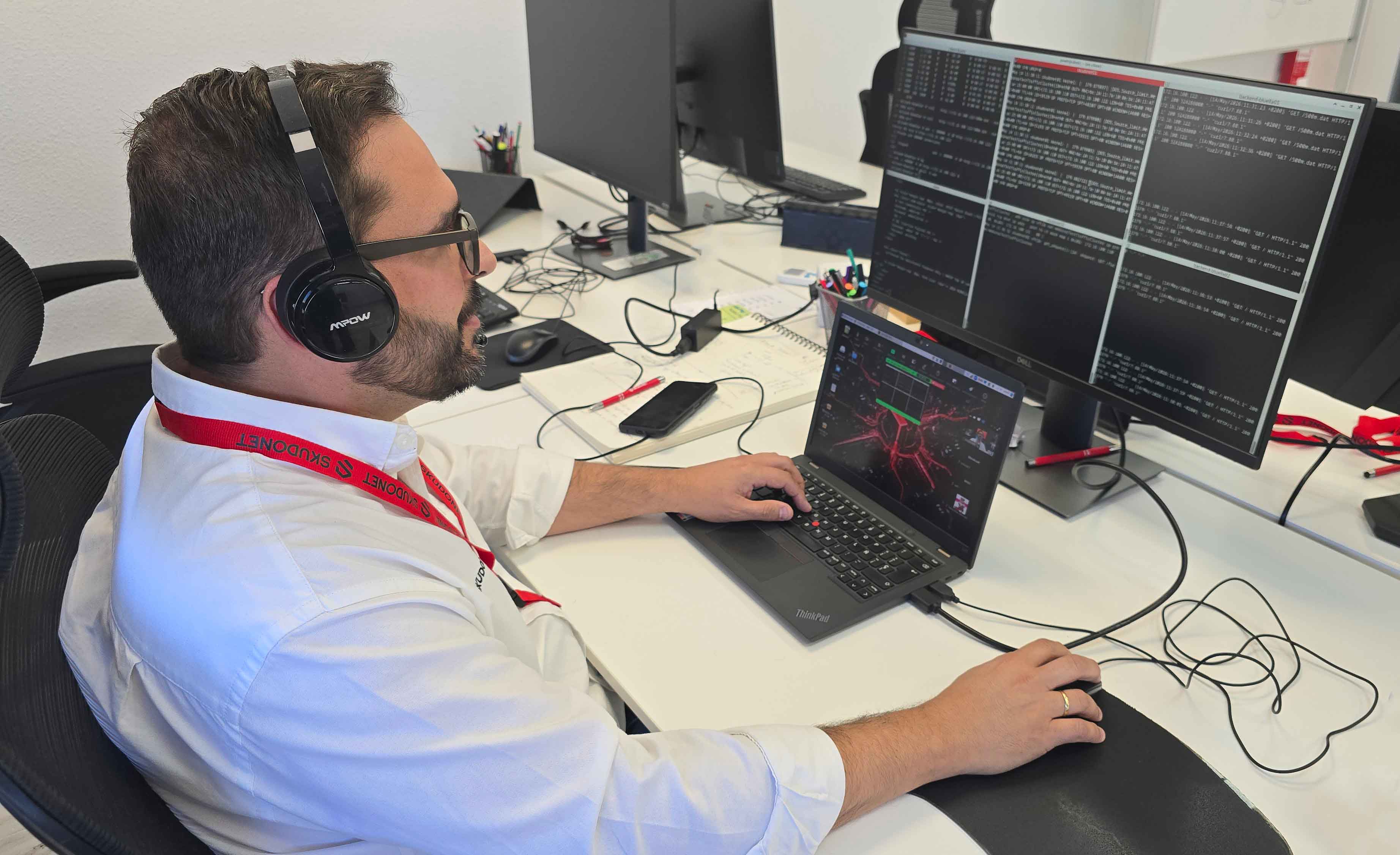
Throughout the webinar, we recreated several scenarios using the SKUDONET Application Delivery & Security Platform, demonstrating how modern infrastructures behave when traffic spikes, backend services become unstable, or malicious requests begin targeting exposed applications.
The session brought together professionals working across cloud, infrastructure, DevOps, and cybersecurity environments, and one of the most rewarding parts for us was the level of interaction during the event itself.
Many attendees stayed connected after the webinar officially ended to continue discussing deployment models, traffic visibility, failover strategies, and application security challenges they are currently facing in production environments.
We also want to thank the Bluella team for the collaboration throughout the entire process. From planning the session to coordinating the live demonstrations, it was genuinely a pleasure working together as partners.
Further below, you’ll also find a technical assessment designed to help teams evaluate how prepared their infrastructure really is under pressure.
Assess Your Infrastructure Readiness
Moving Beyond “Slide-Driven” Webinars
One of the recurring ideas during the session was that modern infrastructure problems rarely look dramatic at the beginning.
Most incidents don’t start with systems suddenly collapsing.
Instead, they usually begin with small signs:
- latency increases slightly
- requests start behaving differently
- backend nodes become inconsistent
- traffic patterns stop looking normal
And in many cases, by the time teams fully understand what is happening, they are already reacting under pressure.
That’s why we wanted the webinar to focus less on theory and more on operational behaviour.
Rather than presenting isolated product features, the demonstrations focused on how load balancing, high availability, Web Application Firewall (WAF) protections, and traffic inspection work together during real infrastructure stress scenarios.
Load Balancing Under Real Traffic Conditions
The first part of the webinar focused on Layer 4 and Layer 7 load balancing.
During the live demonstration, attendees could see how traffic was distributed dynamically across backend nodes while monitoring concurrency, health checks, and response behaviour in real time.
One interesting discussion that emerged during this section was how operational complexity continues to be a challenge in many environments.
Even today, adjusting traffic distribution policies or deploying failover mechanisms often involves fragmented tooling, manual processes, or long intervention times.
The goal of the demonstration was not simply to show traffic balancing itself, but to illustrate how quickly infrastructure teams need to react when services begin degrading under pressure.
High Availability Is No Longer Optional
Another important moment during the webinar came during the high availability and failover demonstrations.
Instead of explaining failover conceptually, we simulated node failure conditions live while maintaining service continuity through an active-passive cluster configuration.
What became very clear during this part of the session is that availability is no longer just an infrastructure metric.
For many organizations, even small periods of service degradation directly affect:
- operational continuity
- customer trust
- internal productivity
- and revenue generation
Modern applications are now deeply connected to business operations, which means infrastructure resilience is no longer a secondary concern.
DDoS Traffic and Visibility Under Stress
One of the most dynamic parts of the webinar focused on DDoS mitigation and traffic behaviour under stress.
Using live traffic simulations, attendees could observe the difference between legitimate user traffic and malicious flooding attempts designed to exhaust backend resources.
What made the demonstration especially interesting was not simply the attack mitigation itself, but the visibility aspect behind it.
Because one of the biggest challenges during modern attacks is not only stopping malicious traffic.
It’s understanding what is actually happening before systems become unstable.
Many attacks today are designed to degrade infrastructure progressively rather than immediately taking services offline. Performance deteriorates slowly, observability becomes harder, and teams lose operational clarity while trying to identify the root cause.
The session showed how traffic filtering and inspection at the application delivery layer can help isolate malicious behaviour before backend services are affected.
Looking Beyond the Surface: XSS and SQL Injection
The webinar also explored application-layer attacks such as Cross-Site Scripting (XSS) and SQL Injection.
Rather than discussing these threats abstractly, attendees could see how malicious payloads interact with exposed applications in real time and how WAF protections identify and block suspicious requests before they reach backend services.
One of the most interesting conversations during this section focused on how difficult modern attacks can be to distinguish from normal traffic patterns.
From the outside, many malicious requests initially appear legitimate.
But underneath, they may be attempting to:
- manipulate application behaviour
- extract information
- bypass validation mechanisms
- or exploit backend vulnerabilities
This is where application visibility becomes critical.
Because modern application delivery is no longer only about distributing traffic efficiently.
It’s about understanding whether that traffic should be trusted in the first place.
More Than Security: Operational Control
Although the webinar covered load balancing, failover, DDoS mitigation, and WAF protections separately, one common theme appeared throughout the entire session: operational control.
Modern infrastructures generate enormous volumes of traffic, requests, logs, alerts, and behavioural changes.
Without visibility, teams often end up reacting blindly during incidents.
This is one of the reasons why modern Application Delivery Controllers (ADCs) like SKUDONET increasingly combine:
- load balancing
- high availability
- traffic inspection
- observability
- automation
- and application security
into a single operational layer.
The objective is not simply performance.
It’s maintaining control when infrastructure conditions become unpredictable.
A Very Technical and Very Real Conversation
For us, one of the most valuable parts of the webinar was what happened after the official presentation ended.
Several attendees stayed connected to continue discussing infrastructure architectures, deployment flexibility, hybrid environments, operational bottlenecks, and the practical challenges of maintaining application availability under increasing traffic and security pressure.
Those conversations reinforced something we see constantly across the industry:
Teams are no longer looking only for “more features”.
They are looking for:
- operational simplicity
- better visibility
- faster incident response
- integrated security
- and infrastructure that remains manageable as complexity grows
Assess Your Own Infrastructure Readiness
The scenarios explored during the webinar reflect operational challenges that many organizations already face today from traffic spikes and Layer 7 attacks to limited visibility during incidents and increasing pressure on critical applications.
To help teams evaluate their own environments, we’ve prepared a short technical assessment inspired by the same types of real-world scenarios covered during the session:
